

In order to determine why a behavior is occurring you need to take some baseline data. The main type of data taken to figure out function is called ABC data. Antecedent = what happened before, Behavior and Consequence = what happened after. Identifying the antecedents and consequences for a behavior will help clue you into why the behavior is occurring.
ABC data is not easy to take. You are in a busy classroom. Behaviors don’t occur nicely and discretely as one simple occurrence. Antecedents and consequences can easily overlap. The consequence for one behavior can also be the antecedent for the next. Confused? Hang in there. It get easier.
So basically – when taking ABC data you are going to write down what the individual says and does, use abbreviations as much as possible since you may be writing a lot, don’t write down interpretations, include time (what time the behavior happened, how long) if possible, include how many behaviors occurred together, and note other important things that happened that day – did you have gym? something specific for lunch? did the child take the bus instead of mom or dad driving them?
That’s a lot of information. There are some ways we can make this process simpler. If that doesn’t sound doable to you – don’t worry! That doesn’t sound doable to me either.
How to Make ABC Data More Efficient
- create data sheets where you can just check or circle options
- don’t take data all day!
- Pick a few time periods throughout the day.
- (ie. from 9-9:30, 12- 12:45 and 1:30-2 and record during those times the next day do the opposite time periods)
- use staff to take data

Here are some examples of ABC data sheets that are easy breezy:
Super detailed: ABC data sheet
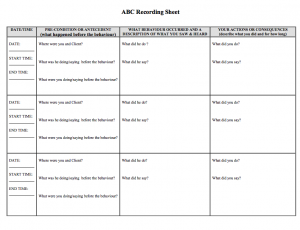
Pretty Basic: ABC data sheet – For this sheet, you could write in consequences or antecedents that frequently happen. For example, under consequences, if usually kids talk back to student, teacher reprimands, or student is ignore you could write abbreviations for each and write them in each box under consequence. Then photocopy the page you wrote on and then when you are taking data you can just circle the consequence that occurred.

ABC Checklist: This one could be used quickly in situ!

I recommend finding what works for you and is easiest. My motto: if it’s not easy and too complicated – you won’t do it! Figure out a system that you will use.

This post is part of Summer Series: Reducing Problem Behavior. Click here to see more in this series!


- Planning for the Fall: Part 4 and 5 – Visually Structured Tasks and Routines - January 30, 2026
- Using TAH Curriculum for Homeschooling from a Homeschooling Parent - September 10, 2022
- Using The Autism Helper Curriculum for Homeschool - August 8, 2022

23 Responses
So helpful! I am passing this post along. Thanks!!!
I absolutely LOVE your posts! With all of the various data that you take, how do you manage recording on your data sheets while still teaching/working with your students?
Thanks, Kim! That’s why prioritizing is so important and taking the most efficient and easy to take behavior data! It can be very challenging but when the behaviors are super disruptive and/or dangerous it’s essential to make time for.
You are simply amazing!!! Thank you for sharing all of your knowledge!!! You have given me so many fantastic ideas I’m having a hard time deciding which ones to use first 🙂
So happy to hear! Thank you so much for reading! 🙂
Thank you for sharing your sheets! This will be so helpful. Quick question – on your sheet (the one with the gray boxes), what does the “IV” stand for? Thanks!
Intervention – so any interventions that you are using! 🙂
Thanks for sharing all of your helpful information.
It is always good to get new ideas!
The link to the “complicated” data sheet seems to be broken. The error message says “The system cannot find the path specified.” Would really like to trial this doc. Can you fix the link?
This document is very useful it has helped understand Challenging behaviour and assessment of challenging behaviour. it is one of the key documents to used every teacher.
Love the sample ideas. I’m trying to help my sons special education class improve their communication log to have more ABA specific terminology (ABC’s I’ve come to know and love when working with my son at home). Just curious if you have any ideas on how to include an ABA data sheet along with daily classwork correspondence and teacher input? Right now they are using a very generic communication log, but with my son in the special education program we need more details. ABCs of behavioral incidents (I have ideas for that) but myself (along with another parent) would like to see class schedule with specific areas needing improvement as well as personal achievements…. any ideas???
LOVE that idea! What about a weekly data sheet like this one. It’s editable and they can send a copy home at the end of the week so you can see where he is at on all goals. https://theautismhelper.com/45990-2/
Hi! I know this post is older but in just staring down this path with my 5yo son. I’m wondering if there’s a PDF available of the last checklist in this post? It’s the best one I’ve seen and I think it will be easiest for his teacher to manage. Thank you for the great info!
Jessica, you can download the ABC checklist right from that blog post! Open the link, click “print” and then save as a PDF!
Hello the third link down for ABC data sheets listed “pretty basic: ABC” is not opening for me. Anyway you could send this to me via email? This is an amazing worksheet! I really need it and can’t figure out how to make one
Email [email protected] and she can send it to you!
This was very helpful! It would allow me to collect data regarding trigger points, and maybe give me information on how to avoid the triggers before they happen. In addition, try to come up with ways to off-set those time-frames.
Great to hear this was helpful! Thanks for reading 🙂
very helpful! Thank you
Happy to hear this was helpful! Thanks for sharing!
Thank so much.
None of the links work for me. Two or three may be helpful for the gen ed teachers I work with. I’d like to make copies, but I can’t get to the links.
Hi Jill! I apologize for that inconvenience. Most of those were links to data sheets available through non-TAH sources and are no longer available. I updated the blog post to remove them. There are still three free data sheets linked here that work!