
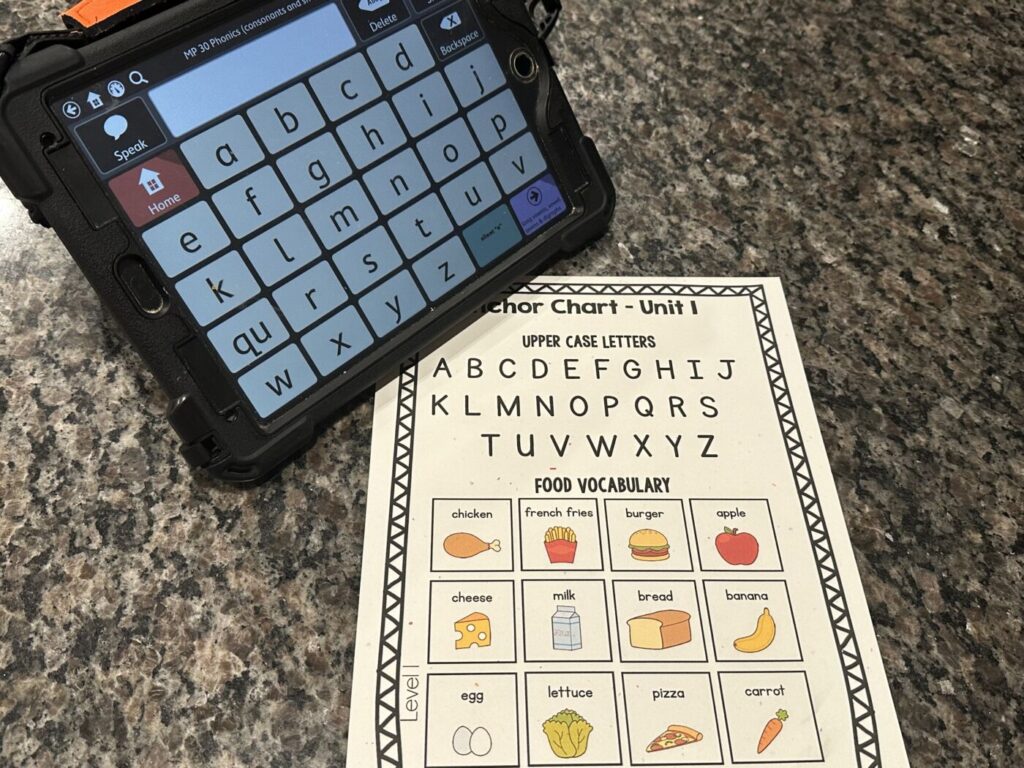
Homeschooling a child who uses AAC (Augmentative and Alternative Communication) brings both flexibility and opportunity. Every subject, whether it’s reading, math, science, social studies, or language arts, offers chances to practice both academic skills and communication. By weaving AAC into your homeschool routine, you’re not only teaching the curriculum but also helping your child find their voice.
Reading Comprehension with AAC
Reading activities can move beyond answering questions, AAC helps children practice core literacy skills too.
- Answering WH- Questions: Use who, what, where, when, why buttons to respond to comprehension questions.
- Sequencing & Retelling: Retell stories with first, next, then, last.
- Word Matching: Match vocabulary words by selecting them on the device.
- Identifying First Letters: Use the keyboard or sound page to tap the first letter.
- Letter Sounds: Tap letters to practice phonics sounds.
- Matching Upper/Lower Case: Find and pair A with a, B with b, etc.
- Building CVC Words: Use the keyboard to spell simple words like cat or dog.
Language Arts with AAC
Language Arts is full of opportunities to practice spelling, grammar, and writing with AAC.
- Letter Identification: Find target letters on the keyboard.
- Letter Sounds: Tap a letter to hear its sound and reinforce phonics.
- Spelling Practice: Spell sight words and word lists on the device.
- Sentence Building: Use sentence starters like I see… or I like… to build complete thoughts.
- Grammar Sorting: Identify parts of speech (noun, verb, adjective) by finding examples on AAC.
- Vocabulary Growth: Add and model new words that come up in lessons.
Math with AAC
Math activities can easily include AAC to reinforce vocabulary and problem-solving strategies.
- Counting: Tap numbers in order while counting objects.
- Comparisons: Use words like big, small, more, less, equal when comparing groups.
- Operations Practice: Say plus, minus, add, take away, equals during math problems.
- Shapes & Patterns: Label circle, square, triangle or repeat to describe patterns.
- Word Problems: Use how many, groups, total to set up story problems.
- Explaining Thinking: Encourage responses like I counted or I used blocks.
Science with AAC
Hands-on science activities pair naturally with AAC because students are always asked to describe, compare, and explain what they notice. A great example is exploring the five senses.
- Five Senses Vocabulary: Connect each sense with body parts and verbs. For example:
- I see with my eyes
- I hear with my ears
- I taste with my mouth
- I smell with my nose
- I feel with my hands
- Comparisons: Use same and different when comparing what is seen, heard, or felt.
- Colors, Shapes & Sizes: Label objects with descriptive words like red, blue, circle, square, big, small.
- Observation Language: Encourage phrases such as look, see, change, grow to describe what is happening.
- Cause & Effect: Use responses like it sank, it floated, it melted, it grew to report results.
- Predictions: Model I think it will… before testing an idea.
With AAC, science becomes a chance to connect vocabulary, body awareness, and descriptive language, all while exploring the world through hands-on discovery.
Social Studies with AAC
Social Studies builds connections to people, places, and cultures. With AAC, children can join in activities by using the vocabulary they need to share what they know.
- Maps & Geography
- Use words like map, city, state, country, river, mountain.
- Practice positional words such as up, down, left, right to describe locations.
- Example activity: Point to a map and ask, “Where is the school?” , your child can answer city or here.
- Communities & Rules
- Add vocabulary like school, home, park, rule, leader, helper.
- Encourage opinion phrases like I like or I don’t like when talking about community helpers or classroom rules.
- Example activity: While learning about a firefighter, your child can say help or firefighter on their device.
- Holidays & Traditions
- Use comparing words like same, different, special, important.
- Encourage students to describe food, clothing, or activities from a tradition (eat, celebrate, family).
- Example activity: Compare two holiday traditions. A child could say different food or same family.
Final Thought
AAC is more than a communication system, it’s a learning tool. By connecting AAC to homeschool activities across subjects, you give your child daily opportunities to practice academics and communication at the same time.

- AAC Awareness Month: Building Language Every Day in Your Homeschool - October 22, 2025
- Using AAC to Support Your Homeschool Curriculum - September 29, 2025
- Back to Homeschool: How to Assess Where Your Child Is Starting This Year - August 25, 2025


