
I spent the past few days talking about tips and methods for teaching emerging verbal skills and responding to questions. This is a secret, weird obsession of mine. Teaching question answering. I told you. It’s weird. But honestly I could have a whole separate blog dedicated to teaching questions answering. Wouldn’t that be even weirder. It’s one of those obsessions that makes you know you are in the right field. The title of my thesis for grad school is Using Multiple Exemplar Training and a Transfer of Stimulus Control Procedure to Teach Question Answering to Children with Autism. That’s a mouthful. Sometimes when friends or family members outside of the field ask me what my thesis is on I just rattle off the entire title and watch their dumbfounded face. I know, such a jerky move. I just like sounding really intense and complicated … even though I’m really not…
My question answering obsession obviously makes sense since I work with children with autism who by definition have significant impairments in language and social skills. Well – question answering = language + social skills. Over the past few years I have realized how vitally important question answering is. It’s how we make friends, it’s how we are assessed, it’s how we get what we want. It’s a safety concern. It’s a functional independence concern. It’s an academic concern. Have I convinced you? It’s everything.
I have spent many hours of my life watching my beloved babies struggle answering questions. Sometimes they remind me of those bing.com commercials that were always on tv a few years ago. I ask them ‘who’s birthday it is tomorrow?’ and they say Tuesday… cupcakes… ice cream… chocolate frosting… sing… November… song… party… vanilla frosting… You get the point. They are trying so hard to answer the question but cannot discriminate what is being asked of them. The language processing challenges take over. Children with autism have such difficulty identifying exactly what is being asked of them.
Okay – I was totally not intending to go on this tirade. Thanks for bearing with me…
Anyways – one type of question that is critically important to answer are personal information questions. You need to be able to identify yourself and other important aspects about your life. We work on answering personal information questions all the time in my class. This will lead to increased functional independence and improved friendship making capabilities.
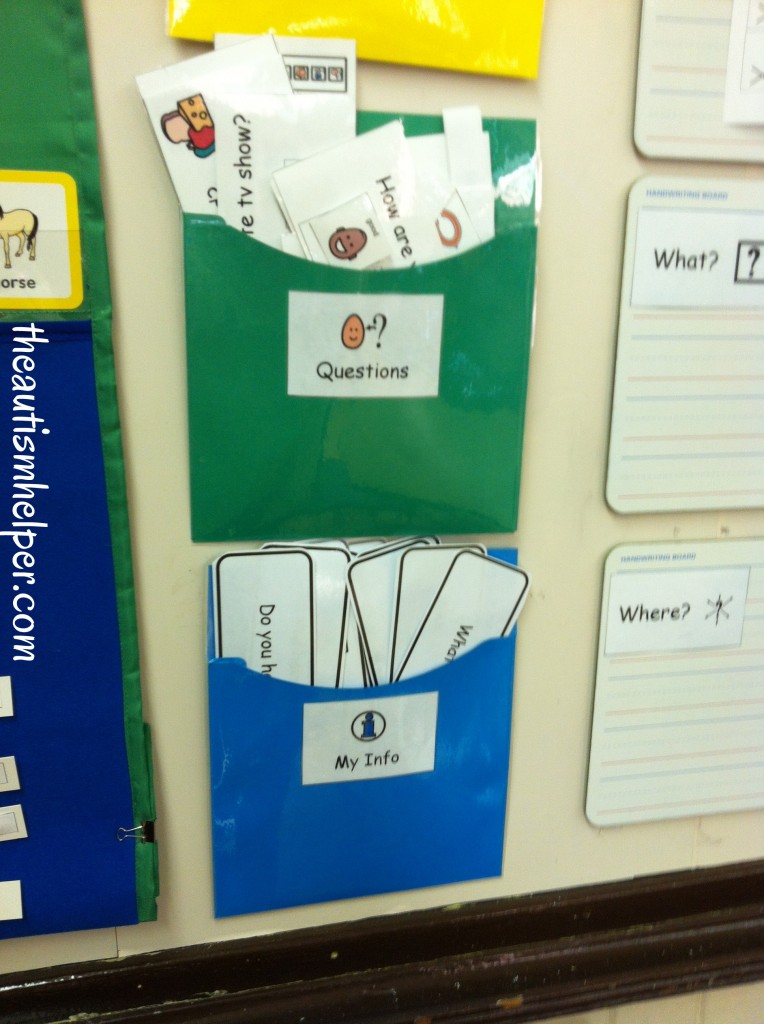
We use these visual personal information questions during our social skills time in morning group. I like having them written out with a visual cue because it helps my students ask each other these questions and provides a nice prompt to answering a question that can be difficult.

I store them under my Visual Questions (Set 1 and Set 2) in my morning meeting area. (sorry again about the mess up with the freebies yesterday – I’ll get those to you by Wednesday!)

Get these questions for free – Personal Information Questions Packet and make sure your students can answer questions about themselves.


Here is a little sneaky tip if you are going to use these. I had a hard time using these when I would ask my students what their address, phone number, or birthday was. Because they would answer and I would have not freaken idea if they were right or not. If you are able to memorize all your students’ information – I’m impressed. I am no that impressive. So I made a little sneaky cheat sheet that I laminated and velcroed right near my morning group area So now I know when my kiddos are right or wrong.


- Planning for the Fall: Part 4 and 5 – Visually Structured Tasks and Routines - January 30, 2026
- Using TAH Curriculum for Homeschooling from a Homeschooling Parent - September 10, 2022
- Using The Autism Helper Curriculum for Homeschool - August 8, 2022
22 Responses
These are fantastic – thanks so much! My students definitely need practice on personal info 🙂
Kara
Spedventures
Whilst my students are proficient in reciting the entire Pokemon catalogue, Plants vs Zombies stats, Angry Bird levels and other fun facts, many cannot tell me their middle name, mum’s name or even the year they were born. These will be well used. Thank you again for so graciously sharing 🙂 I learn so much from you.
You’re welcome Kelly! I’m sure my kids are just fluent at angry birds as yours haha!
Glad they are helpful to you Kara!
Hi!
I’m a ESL student.
I want to leanr English
so I need ‘wh-Question sentence’
could you please give example?
Thank you!!
great work! These will help teach my kiddos their personal info. =)
I am struggling with this right now, all of my student are non-verbal, and would really like to work on this with them. Can you give me any suggestions as to how I could teach them to how to communicate their personal information.
I would work on receptive language skills – with a field of response options – Find your name? Which city do you live in? And have them point to the correct answer. Also you could use alternative communication systems (PECS or AAC device) for answering these questions!
I do something similar to this. Another question I added is “What colour are you eyes?” We were filling out an application at school and my student did not know the answer.
Great idea!
Since I have a 12 year old student who has a stroke and language delay, this packet saved my life because I struggled what to teach him.
I am so happy this resource has been helpful to you. Your son is lucky to have such a dedicated mother 🙂
What are your thoughts on students learning parents’ names? No harm, right?
I think it’s important! If you get lost from a parent, you need to know your parents’ names beyond mom and dad! 🙂
This brought tears to my eyes. I desire to fully help my students with their challenges and your obsession sounds like it needs to be higher on my priority list. I’m in the middle of writing reports and realised that one of my students has learnt some wonderful facts about the Earth’s environment and can now write a 5- digit number, correctly placing the zeros where they are required but still can’t tell me which month his birthday is in. As much as I am not overly fond of report writing, it provides a great opportunity to reflect on goals I have worked towards with my students and other things which I had overlooked. Thanks so much for your insights and for these personal information prompts which I will add to our Speaking and Listening program.
Thank you for sharing & reading along 🙂
So you have this available for purchase on Teachers Pay Teachers?
Hi Amy – you can find the visual questions here: https://www.teacherspayteachers.com/Product/Visual-Questions-for-Children-with-Autism-407508 & the personal information packet here: https://theautismhelper.com/wp-content/uploads/2012/11/personal-information-packet.pdf
Thanks for reading 🙂
Hi sasha i’m really interested in using your free personal information packet but when i click on the link it says no information found could you please help me with this problem. thanks! You’re doing an amazing job!
Hi Jayden, thank you so much for your kind words! You can find the personal information packet here: https://theautismhelper.com/wp-content/uploads/2012/11/personal-information-packet.pdf
Hi!
I am endevoring to teach my kiddos their personal information and loved how you set up your morning time center. When I saw the questions were for free I got even more excited-but the link to get them is not working. Is there another place where I can obtain them? Please and thank you! 🙂
So sorry but this is a really old post and this resource is now part of this bigger product: https://shop.theautismhelper.com/products/personal-information-mega-pack-level-1?_pos=4&_psq=personal+infor&_ss=e&_v=1.0