

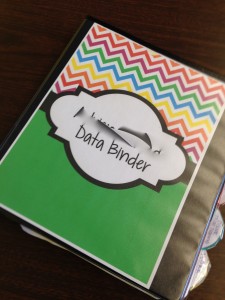
A program binder will guide your instruction and help you keep track of both academic and behavioral data. However, there is a lot that needs to go into one binder and the organization can be challenging. If you have a high-needs student, you cannot waste time trying to find the right page or clarify what you are working on. In those critical few seconds of searching through pages, your kid is gone. You need a system that is easy to use so you can keep up with your student! There are a few keys to creating this efficient and effective system!
1. Use tabs to organize the different sections.


2. Keep behavior data up front and easy to access. Include behavior definitions.


3. Keep IEP goal data together. Organize by type of data (fluency and discrete trial) or have a tab for each goal.

4. Put the program description/guide (how the adult runs the goal) in front of each data sheet.


5. Create a checklist to track how often each program/goal should be done with the student. This helps hold all adults accountable.


If you follow these steps, you will have a program binder that is easy to use. Remember my mantra – if it’s not easy – you won’t use it! When creating a data system like this – make ease of use your first priority!


- Planning for the Fall: Part 4 and 5 – Visually Structured Tasks and Routines - January 30, 2026
- Using TAH Curriculum for Homeschooling from a Homeschooling Parent - September 10, 2022
- Using The Autism Helper Curriculum for Homeschool - August 8, 2022

19 Responses
I’m putting data binders together …. thanks!!!!!!
I love the accountability sheets. Mine are a little more time intensive for my staff, I might switch to a quick check mark system! Thanks for the idea.
Hello, Do you write all your own program descriptions/guides? Or do you use a certain resource as a guideline? I write all my own, but have been wondering if something exists out there that would be helpful to use. Please let me know. Thanks.
I love these data binders. I currently use something similar, I keep my students data sheets in a folder. I really like how you added the sheet about the description guide to take data. I need to add it to my data folders.
Let me know how it goes!
Yep – I always go for quick & easy! Hope this helps 🙂
Yep and I have the perfect resource for you! Check these two out:
https://www.teacherspayteachers.com/Product/Discrete-Trial-Goal-Sheets-and-Data-Forms-Set-1-EDITABLE-432409
https://www.teacherspayteachers.com/Product/Discrete-Trial-Goal-Sheets-and-Data-Forms-Set-2-EDITABLE-1080035
All are editable! 🙂
Thanks for sharing! Yes – I think the program description helps during staff training and for organization! 🙂
How do I find some of the forms to create data binders for my paras? I need them to start actually helping me instead of me doing all the work.
Yes! They are all included within these resources:
https://www.teacherspayteachers.com/Product/Discrete-Trial-Goal-Sheets-and-Data-Forms-Set-1-EDITABLE-432409
https://www.teacherspayteachers.com/Product/Discrete-Trial-Goal-Sheets-and-Data-Forms-Set-2-EDITABLE-1080035
https://www.teacherspayteachers.com/Product/Discrete-Trial-Goal-Sheets-and-Data-Forms-Set-3-EDITABLE-1622364
I’m a first time teacher and I would love to have something like this in place. How can I get samples pages and an actual set-up guide?
Check out our discrete trial products: https://www.teacherspayteachers.com/Store/The-Autism-Helper/Search:discrete%20trial
Everything is included!
I’m setting up my student data binders now, but I always have such a difficult time deciding on the right kind of data sheet to use for each goal! In Ohio, we typically have to write our IEP goals with a percentage and trials (i.e. “80% accuracy in 4/5 trials”) for most goals (behavioral and social goals are usually a little different). Should I just use discrete trial forms for those kind? thank you!!!
You can still use a discrete trial data form. You will just need to figure out the percentage when determining benchmark success but you would need to anyways. Hope this helps!
Do you have a download for your forms? I am a new Special ed teacher and it takes hours to find good forms.
These are all from my Discrete Trial Data Sheets and Program Forms sets. Here is a link to the different versions: https://www.teacherspayteachers.com/Store/The-Autism-Helper/Search:discrete+trial. All are editable! 🙂
I like your content paper .. from where you get it ?
Hi Sasha,
Do you have templates for these binders? I am new to a subseparate classroom and I am trying to put together a binder for my students.
Hey! Check out all of these data sheet packs! https://shop.theautismhelper.com/search?q=goal&options%5Bprefix%5D=last