Some rules for prompt fading:
-
Plan it out from the start.
-
Train your staff.
-
Do it gradually.
-
If incorrect responding begins, return to last prompt level.

Some key tips for using this prompt fading procedure:
- allow wait time; if you do not provide wait time you may be providing more prompts than needed and taking away the opportunity for the student to respond correctly
- take data; data is key to track progress. Every time you utilize this prompting method – note the level of prompt you used. You want to see that your student is requiring less intrusive prompts as time goes on. This will help avoid prompt dependence.
- use high powered reinforcers; use an item that is actually a reinforcer that your student wants to work for. The sooner he demonstrates the skills, the sooner he gets the reinforcer.
However, some children learn to “wait” for the prompt, meaning over time their learning history has shown them that if they do not respond a prompt will come and reinforcement will follow. Students may have never responded correctly with a less intrusive type of prompt and have never contacted reinforcement. If this occurs you can try most-to-least prompt, a time delay (we will talk about tomorrow), or re-evalute if you are using this strategy correctly (ie. providing wait time, using a reinforcer, etc.)

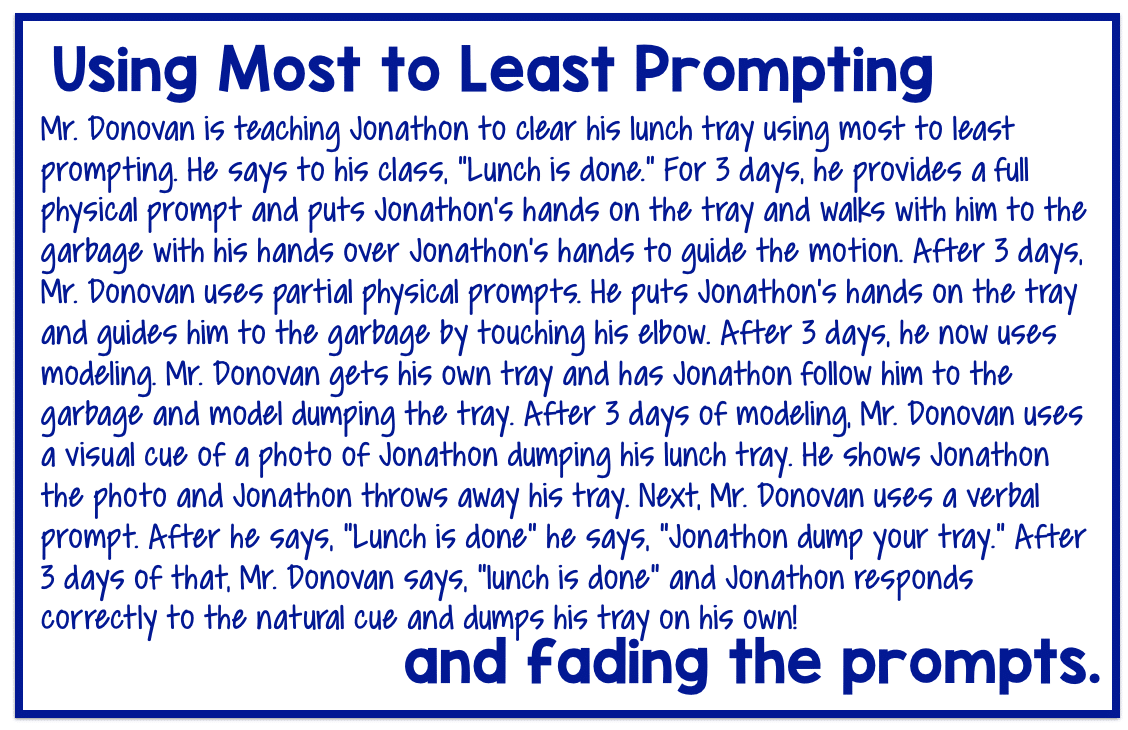
How to fade prompts in Most to Least Prompting:
- set criteria for changing prompts; once your student hits a particular number of days or sessions or trials at a particular prompt level, fade to the next level; take data to track progress
- once you hit the criteria move to the next type of prompt; refer to our prompt hierarchy or order that is in Monday’s post. Move up the list to less and less intrusive prompts.
- fade magnitude than switch prompt type; before you switch from a gestural to a verbal prompt adjust the magnitude of the prompt. A dramatic point to an object is different that a nod of your head.
Data is critically important for avoiding prompt dependence. You want to set a criteria ahead of time and take data to make sure you are sticking with the criteria. The criteria you set will depend on the student and the task. Maybe you want 3 consecutive days with each prompt level. If you are taking data you can ensure that you are sticking to that schedule. If errors begin occurring, go back a prompt level. The data will guide your implementation of this procedure. If you are fading too quickly, your data will tell you!
Prompt fading isn’t scary. Plan ahead and make sure to train your staff. This a group endeavor! In tomorrow’s post, we will review use time delay to fade prompts!
There is no magic number of trials or days you should stay within the 0 second or 2 second time delay. It depends on the student’s level of functioning and the difficulty of the task. This is where data majorly comes in to play. If you’ve moved along too quickly, you will know and you can scale back.
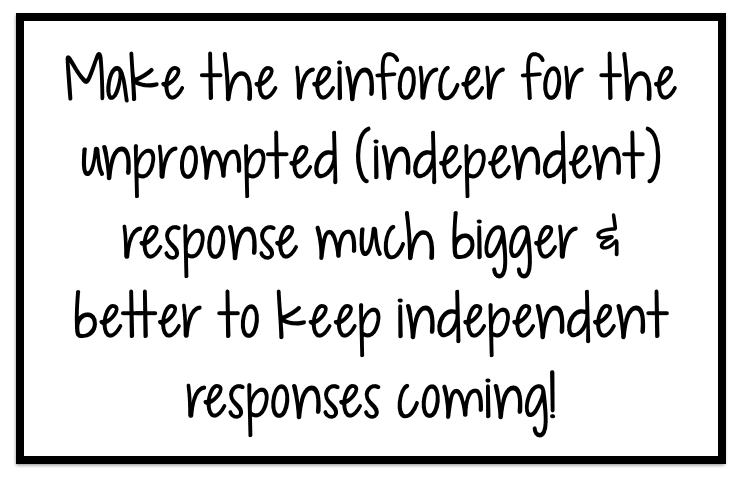
Time delay works really well with verbal prompts. Another key component to time delay working successfully is making sure the reinforcement you give for the unprompted responses is better than the reinforcement for prompted responses. So if Johnny responds before the time delay and says the color blue on his own – give him 3 m&ms and praise but if you are using a 2 second time delay and he doesn’t respond and you provide the verbal prompt “bl…” and then he says blue only provide praise. You want the independent responses to be getting more reinforcement so your student is motivated to engage in those responses more!


- Planning for the Fall: Part 4 and 5 – Visually Structured Tasks and Routines - January 30, 2026
- Using TAH Curriculum for Homeschooling from a Homeschooling Parent - September 10, 2022
- Using The Autism Helper Curriculum for Homeschool - August 8, 2022