

My writing centers are one of the pride and joys of my classroom. The structure, flexibility, and ability to individual makes me smile. I am now starting year 3 with them and I find that I am always able to make them more complex for my students who have more experience with writing and use them as a perfect guided direct instruction activity for my guys who are newer to this writing game. In addition, these centers take up a little less than two shelves which in my busting-at-the-seams classroom is a insanely ideal. And most importantly – they are so dang pretty! 🙂
Words of Wisdom about Teaching Writing to Children with Autism:
- It’s so hard. Ugh.
- It gets better! I used to dread doing journaling with my kids and now I love it.
- Practice, practice, practice, practice… you get it. And I know that it’s this way with all kids, but I think because of how difficult the language piece is for our students it can take that much longer.
- Almost everything needs to individualized and one on one. It’s probably not this way for all kids with autism – but the group I had last year really needed the individualized support.
- Some kids excel at imaginative writing and others just can’t seem to get it. I wonder if it’s because our kids are so visual and routine based. I had the saddest moment last year where I got one of my kids to write this really awesome story about going to carnival with all his friends and eating purple ice cream and all other crazy things. I thought we had made this huge breakthrough on using our imaginations. I was getting all ready to pat myself on the back for being the world’s best teacher, when my student brought me over his calendar and wanted me to show him exactly what day we’d be doing this purple ice cream eating carnival trip. Ugh.
- You have got to DRILL those component skills. We do tons of work on answer wh- questions (who, what, where, when, why), sentence building, and real vs. make believe to in turn – build writing skills.
Okay so the idea behind the writing centers is that students will pick a center to work on each day to practice a variety of writing skills including target descriptive writing, narrative writing, sentence building, sequencing, making inferences, vocabulary building, imaginative writing, and more. But since the structure will stay the same – ie. the centers – it will provide the routine my kids need. I plan on keeping the centers the same throughout the year and just making them more complicated/complex as we more on. So now for some pictures 🙂
- Best part of this: It only takes up a shelf and a half!!! (The yellow binders are part of the language center.) The colored binders, 2 gray bin, and finished bin – that’s it 🙂

- Students check in:

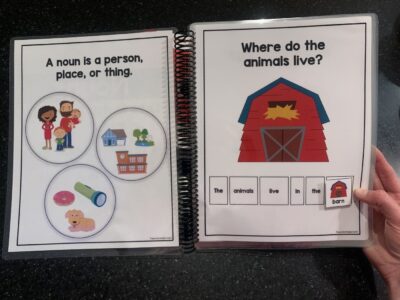
- Each center starts out with a simple direction page with visual cues.


- Some of the center materials:

- All centers have matching labels (duh…)


These 10 centers are available on TpT. The packet includes labels and visual directions for all 10 centers, prompts/worksheets/printables for the content of each center, photos and directions for setup, the clothing pin schedule, and the following 2 anchor charts (which I post in the front and back of each center).


Click on the pic below to see this product on TpT – it’s one of my all-time best sellers! 🙂


- Planning for the Fall: Part 4 and 5 – Visually Structured Tasks and Routines - January 30, 2026
- Using TAH Curriculum for Homeschooling from a Homeschooling Parent - September 10, 2022
- Using The Autism Helper Curriculum for Homeschool - August 8, 2022

12 Responses
Just purchased this and I’m excited to get in my classroom to set it up!! Thanks!
What grade level do you teach?
How do your students that don’t write complete journaling on their own? I have 2 students who have difficulty writing (they are learning to use stamps) and one just learning to write.
Sasha I LOVE this. I have done writing with my students in the past, but my current group is way lower functioning academically. Do you typically have our this center as independent work, or does a para run it? My students right now would not be able to read the directions or prompts, and unfortunately our visual supports just won’t be enough for them to figure it out. Any advice? Thanks!
What writing ideas do you use with your lower functioning students?
Awesome! Let me know how it goes!
Grades 5-8 but level of these centers is early childhood skills (1st-3rd). Most of the centers can be made easier/harder to adapt for each student.
I have them do these centers with assistance of an aide. Some accommodations we make: copy from sample, scribing, writing in highlighters and having student fill it in, stamps, AAC device, & drawing pictures. Hope this helps!
I started this as a direct instruction activity. Some of my students still need adult support when doing the centers. Others now just need a little check in. This would be a great center for a para to run and go through each step with each student. Sometimes the visuals and prompts are helpful for the paras running the center too!
Great question! I have them do these centers with assistance of an aide. Some accommodations we make: copy from sample, scribing, writing in highlighters and having student fill it in, stamps, AAC device, & drawing pictures. Hope this helps!
I am so excited to use this in the fall. I teach a 5th and 6th grade special education/resource. I LOVE that these materials are age and level appropriate. Do you make an add on packet to go with this. For example, more sentences for super sentences, additional writing prompts, more pick a subject, pick a stick, and words like! I know I can always make up my own and make more! But, I LOVE the ease of going to TPT and just printing up all of the needed resources and materials!
Enjoy! Let me know how they go!