
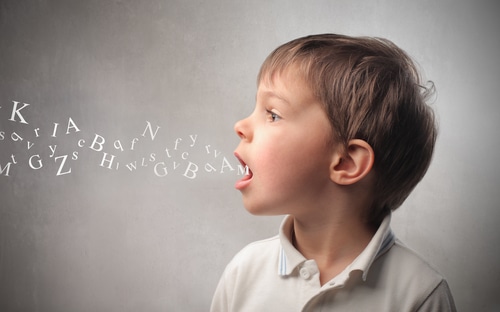
A vocal imitation program is a good way to help train up sound approximations! This is ideal for students with very limited vocal skills, but who can make some sounds and imitate novel on. To start things off, identify one or two approximation your kiddo can sound out successfully, then identify two or three more that you want to train. These can be approximations to actual words you’d want the student to use throughout their day. For example, as an approximation to bubbles, a highly preferred item, I might teach my kiddo to imitate “buh” as an approximation.


Once you’ve identified your first set of approximations to teach, let’s identify our reinforcers!
It is highly recommended that, to start things off, you include approximations your kiddo can sound out successfully without much training so that, from the get go, he can access some rewards!
Since we are teaching new skills, we want to include some really preferred items as rewards for correct responses. At the same time, you want to use items/activities that your kiddo can enjoy for a brief moment before the next trial. I’ve found that mini-marshmallows are great as edibles during vocal imitation programs (provided your kiddo loves marshmallows!). The general idea here, is that they can consume it quickly, each bite is tasty, and they won’t get too much in one session. Plus! They don’t have to give it back.

Once you’ve identified your reinforcers, let’s start the program! Let’s go through a vocal imitation program we started with Johnny.
For this particular program, we started with a set of sounds that included approximations that Johnny could already make (e.g., “buh”) as well as novel ones he was taught during sessions (e.g., “T,” “OO” and “H”).
We then identified mini-marshmallows as highly preferred items (based on preference assessment for Johnny and had our program guide and data sheet ready (see sample photos). We then had Jonny sit directly in front of the instructor, who then modeled the first approximation (the one he can already make), “buh.” As soon as Johnny says “buh,” he is rewarded with the mini-marshmallow and some praise, e.g., “Nice job Johnny!” Then the next model is provided.
For this specific program, each session included five opportunities for responding to each approximation (a total of 20 opportunities with 4 approximations). As such, the data sheet was designed so that the instructor could record correct (+) and incorrect (-) responses, as well as a tally of the total corrects (which is circled).
These data were then graphed as line graphs so that Johnny’s progress throughout the program could be monitored. Here’s a sample.

Graph showing the number of correct “T” sounds Johnny makes per session.

I highly recommend graphing the data for each sound approximation so you can see how the student is learning across sessions. Once they have mastered a set of approximations, you can introduce a new set, them mix sets up, and so on, while watching you kiddo learn more and more.
Here’s a link for vocal Imitation Program Data Sheets and Program Outlines: Discrete Trial Programs & Data Sheets SET 2


- Planning for the Fall: Part 4 and 5 – Visually Structured Tasks and Routines - January 30, 2026
- Using TAH Curriculum for Homeschooling from a Homeschooling Parent - September 10, 2022
- Using The Autism Helper Curriculum for Homeschool - August 8, 2022
2 Responses
Love this post!
Me too! Love vocal imitation programs!