
1. Visual Data Sheets
The visual data sheets couldn’t possibly make me any happier. If you are taking specific data on student responding towards each word, it is hard to scan a data sheet to find the right word. We NEED our data collection process to be quick. If it isn’t, our student may lose or focus and we will probably stop taking data. Having tiny visuals on the data sheets is KEY. It makes taking data so quick!


2. Easy Setup & Flashcard Free

3. Differentiated Extension Activities
Your work isn’t done after taking data on the vocabulary words. We want to give our kids continued exposure to these words. And hey, remember how all of our classrooms are understaffed and we need a ton of independent work in our classrooms? Yep. Me too… Well, this unit has perfect independent work activities to go along with each set. Your students can match picture to picture or word to picture as well as practice tracing, spelling, or writing the words. We love to use the picture board to copy the words and write the correct spelling. I usually only laminate the pieces and put everything else in page protectors. #easyprepforlife


4. Tons of Theme Options
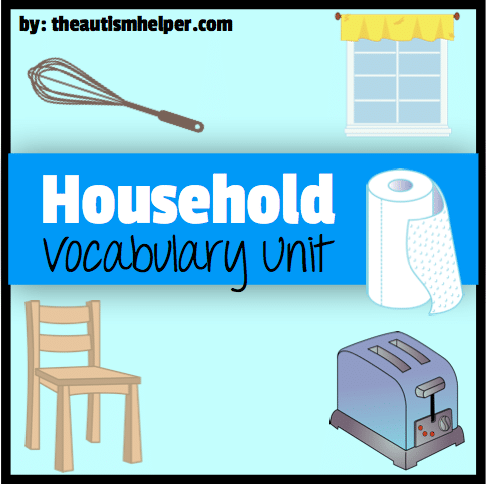
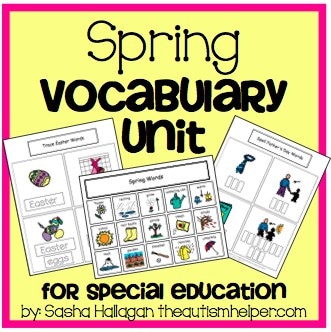
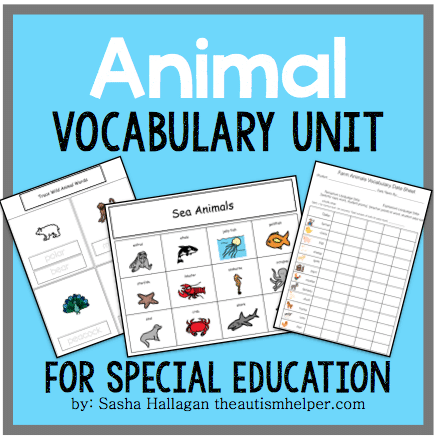
I got on a big roll with making these because they were working so well for my students. It’s important to remember that once our students learn the structure and setup for a task or activity, it’s much easier to just switch out the content and learn new content within that same structure than teach an entirely new activity. Once your students learn the setup of this activity, keep switch out the vocabulary words and they will fly through these! Check out all of the seasonal and functional sets we have. Click on the image to learn more!







- Planning for the Fall: Part 4 and 5 – Visually Structured Tasks and Routines - January 30, 2026
- Using TAH Curriculum for Homeschooling from a Homeschooling Parent - September 10, 2022
- Using The Autism Helper Curriculum for Homeschool - August 8, 2022

4 Responses
I have a couple of questions. I have noticed in your other discrete trial programs, such as with sight words, you may have a set of 3-5 words that you ask the students and have them master before moving on. Do you do that with these words, or do you go through all the words at one time?
I am also wondering if since the vocabulary board is static and does not change, do you think it is possible for the student to memorize the location of the picture and not be able to generalize it or find it in a different location?
Great question! Yes, there definitely is the risk of memorizing – so this would work for every student. I have also laminated the board and cut up the pieces to make flashcards which is a nice option. This system is easy because have the one page makes it simple organization and for staff to use but I definitely want to make sure kids aren’t just memorizing. That’s why I like the other activities (tracing, matching, etc.) that go along with it. Some kids can handle this big of a field but for others – I select a smaller set of words to work on at a time and highlight those on the data sheet. Hope this helps!
How do you work this in with your daily curriculum (math, science, etc.) I bought each subject but am trying to figure out the best way to teach the material. For example, do teach the vocabulary unit before the L.A. material? Or, how do you incorporate the task cards for each curriculum?
Thanks!
So basically what I suggest is using the curriculum as the main framework. Do one page a day and let the topics of the unit be the “focus”. After you finish, the page use other activities such as task cards, adapted books, vocabulary units to extend those ideas and provide a hands-on component. I also LOVE these vocabulary units as a paraprofessional run station. They work super well since the structure stays the same and the content changes. I have set it up where we do a different vocabulary unit each month and it’s a stand alone paraprofessional run station that the kids rotate to!