

Once our students are successfully and independent whipping through that visual schedule on a daily basis, I want you give yourself one quick pat on the back (and your kiddo) and jump right back on that pony. Your job isn’t over. I’m probably starting to sound annoying with all of this “you job isn’t done yet, keep pushing your kids” talk and I get it. Once you have one pristine moment of calm, the thought of even slightly rocking on the boat seems just downright dumb. But here I am, suggesting the stupid move that I promise you will pay off in the long term. Push and challenge your students and get them even more independent!
The Schedule Continuum


We can make each student’s schedule “easier” or “harder” based on their needs. When I say easier, I mean more concrete and readily understandable. And when I say harder, I mean more abstract and more based around text.
What are some changes you can make today?
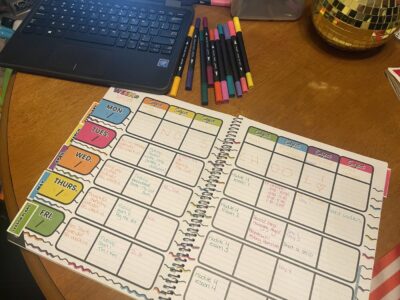
Move the Wall Schedule into a Binder


Make Your Visuals Smaller & Focus on the Text


Happy scheduling!


- Planning for the Fall: Part 4 and 5 – Visually Structured Tasks and Routines - January 30, 2026
- Using TAH Curriculum for Homeschooling from a Homeschooling Parent - September 10, 2022
- Using The Autism Helper Curriculum for Homeschool - August 8, 2022


14 Responses
How do you handle your schedules that don’t have moveable pieces when things change? Example can’t go outside for recess because of weather. Or something going on in the gym so pe is moved. Etc
Thank you for this terrific column. I wish I’d read it way back when…
When I started teaching in my intermediate grade class a few years ago, I was an intern and learning how to set up the room. The previous teacher had left behind two types of picture schedules for the students. One set had large pictures, and the other had larger words and smaller images. Every day I spent time putting up the little icons. I felt compelled to do this day after day for each child. I ultimately went the binder route with a few kids. They loved it – they had moved off the wall so to speak.
Now I’ve been teaching for a few years and I’ve gotten the hang of schedules for real now.
I have a large classroom schedule on the wall with words, times (digital – 8:00) and picture icons. I’ll be adding analog clock times as soon as I can find the right format that is editable. This large schedule works for my class now but not for every child. I’m in the process of setting up a picture schedule (photos) for one student and am evaluating my students for next year (from the primary class) and what they will need to move through the day.
My intent is to encourage independence, lessen anxiety, and manage behavior.
Just put a small piece of Velcro on the top and put the picture on top of it??
I laminate the non moveable schedules then use a wet or dry erase marker to cross out things when there is a change for the day. We often use a star as our symbol for a special activity. So it’s easy to write and draw that item in the side of the schedule.
Thank you for this. I’m in the process of taking one of my students word schedules off the wall and am now confident that he has the pre-requisite skills to do this.
Great questions! For my guys who have written schedule we just write it in – great way to have an easy method of showing changes that is age appropriate and parents can use at home! For my guys with laminated one page schedules I sometimes use clear tape and tape on one the old moveable pieces to show a change or use dry erase markers to cross things off etc. Hope this helps! 🙂
So great to hear! I love thinking about schedules in a flexible way as a kind of “work in progress.” Sounds like your class is doing great 🙂
Great idea!
I do that all the time! Even if kids have a hard time with it initially they do get used to it and it’s so important to learn how to deal with change. Great suggestions, Amy! 🙂
Yay! let me know how it goes! We should start a hashtag #offthewall
With the visual paper schedule where do you recommend having it throughout the day?
This is so important, especially as students prepare to transition into adulthood. It’s important that students have a schedule in a format that can be kept current by adult service providers and families. Many of them don’t have access to the nifty scheduling tools we have in schools. We would really be setting them all up for failure if we didn’t prepare students by fading to the least restrictive schedule possible. So glad you brought this up!
We keep it in a central location in the room in a binder. They store a lot of other daily work in the binder so they do reference it a lot. Many students seem to check the schedule more at the start of the year and once they know the routine – they don’t check as often. Hope this helps!
SO TRUE! It’s our job to get them as ready as possible and we are really doing them a disservice if their method of transitioning isn’t easy to setup and use for job placements and adult services.