Recap of Part 1
In part 1 of my list of proactive strategies (check it out here), I reviewed the beginning steps of being proactive. Whether in a full remote, hybrid, or in person model right now and in the future, these steps will help. Being proactive when teaching is a must. Knowing our learner’s abilities and what they need will help the team be proactive, not reactive. This will in turn help learners be independent and successful! Here is part 2 of my list! I will go over family tools, social emotional resources, visuals for use in the home, communication systems, and the regulatory tools that we have sent home.

Family Tools
Setting our families up for success is something you will likely hear me talk about over and over. Communication is key for our learners to get practice generalizing skills from school to the home. We empower our families and train them in order to feel confident in carrying over strategies and lessons themselves. During remote learning, my team and I are able to do this each day over video conference calls.
STAR stands for Strategies for Teaching Based on Autism Research and this is the alternate curriculum for our structured preschool classroom. We modify the general education curriculum and thematic units. We also use The Autism Helper curriculums, ABLLS, and the VB-MAPP as teaching resources. The STAR overview that we send home explains each area of focus. The handout informs families about the focus on the program, the assessment, the progress report we send home, and how to practice in the home.
We also send home a Zones of Regulation visual. This is a supplemental program that we use to help teach students how to manage and recognize their feelings as well as the feelings of others. When we were in the classroom, we would check in each morning and see how everyone was feeling. During remote learning, it is no different. After we sing our hello song, we say hello to each child one at a time and ask them how they are feeling, using the zones check-in.


Some more resources I have sent home to families to teach and manage social/emotional skills are:
- Social stories (Found Here)
- Social skills rubrics (Found Here)
- Emotion tasks (Found Here)

Paraprofessional Manual Part 2
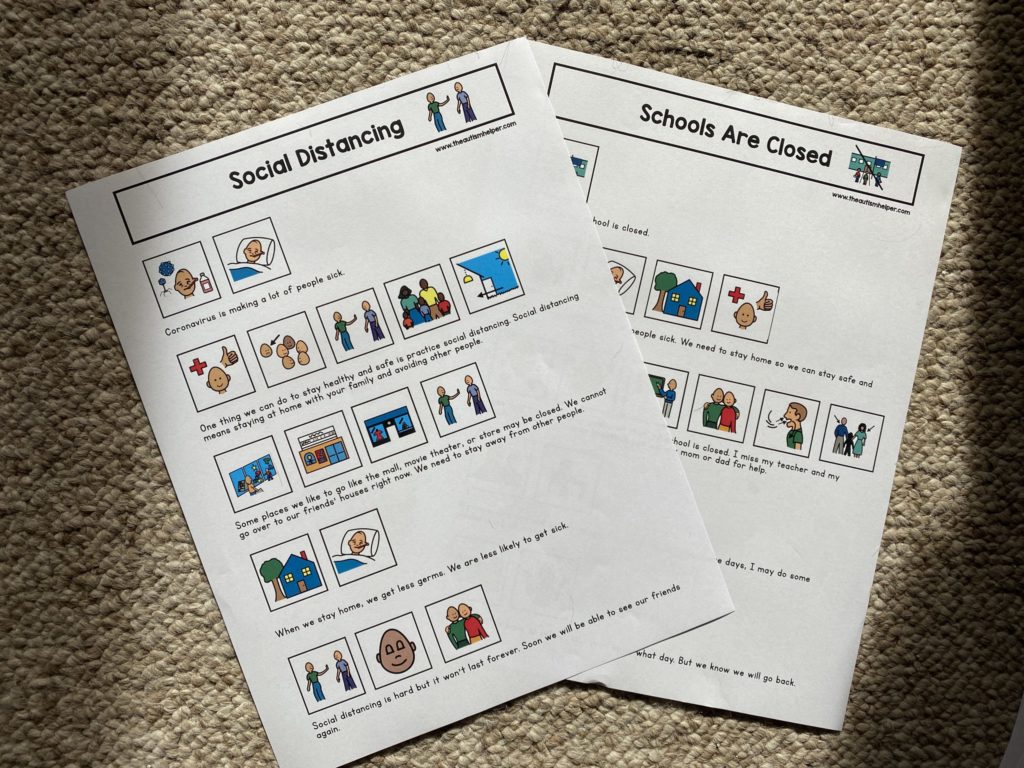
Another great resource for families is the paraprofessional training manual (found here). This resource from The Autism Helper is great to keep together to send home as a packet, or send home one at a time as handouts that go along with conversations with families. I included these 3 handouts (shown above) in our learner’s specialty bags so far this school year. These have been great resources and reminders for our families and caregivers! The manual includes visuals and easy to read language. It is not overwhelming for families or paraprofessionals and contains all necessary information to make a successful team for all learners.


Communication, Sensory Regulatory Tools, and Visuals
In order to carry over independence within the home, we have sent home similar tools to those we use in the classroom. We are also using very similar tools over video conferences during large groups and our 1:1 scheduled times. All of the tools are individualized and specific to the student’s needs in order to be independent and successful.
- Communication: students have Core Boards, modified Core Board with movable pictures, or PECS books. The speech/language pathologist and I work with families each day on how to use these communication tools.
- Sensory regulatory tools: the occupational therapist and I work with the families in order to use these appropriately. Depending on the student, we have sent home fidgets, Theraputty, or chewies to help during remote learning.
- Visuals: we have sent home mini schedules, calendar visuals, and direction visuals for the families to use. If a student needs, we have also created and sent home bedtime routine schedules, hand washing visuals, tooth brushing visuals, and wake up schedules.
Put it all together
Everything in our proactive strategies part 1 (check it out here) and part 2 have helped my team tremendously! We are able to teach, coach, and model the use of all tools and strategies. Our learner’s families and caregivers are their first educators! Whether we are full remote, hybrid, or full in-person learning, these strategies will help with accountability and carry over, help teach families, and help our learners generalize skills. This will in turn help learners be independent and successful!

- Embedding Social Skills Into Every Lesson - November 24, 2025
- Top 10 Must-Do Tasks from a Self-Contained Elementary Teacher - September 22, 2025
- Setting Up the Classroom Environment for Independent Learners - August 20, 2025