
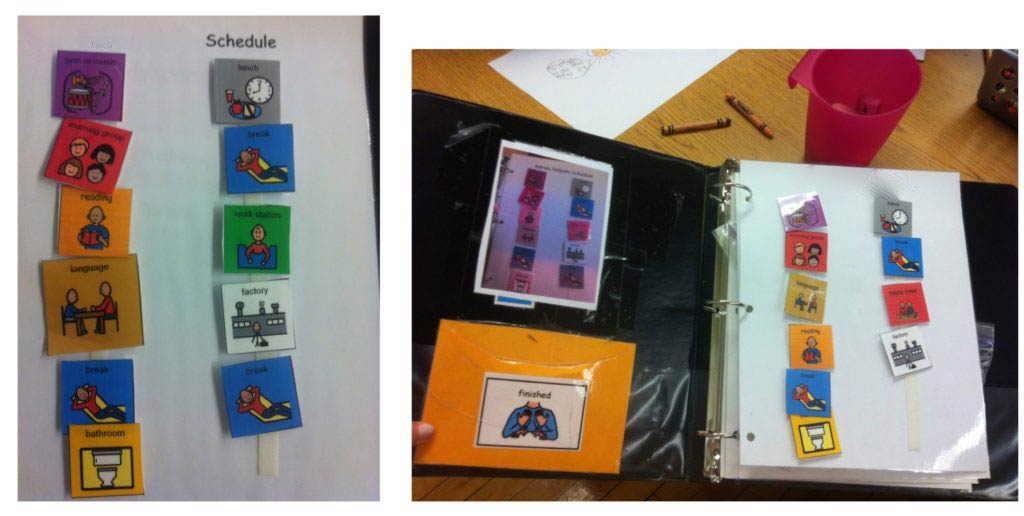
Now don’t confuse schedule with moveable piece laminated schedule. A schedule does not need to be velcro or visual or anything like that. The schedules needs to be individual to the students. There are many different types of schedules and you should be picking the schedule type that best fits the skill set of each student. If that means you have 4 different kinds of schedules in your class – cool. You have 4 different types of schedules in your class. You need to differentiate this process and give each student the schedule that isn’t too easy or too hard – it’s just right! Let’s review the types of schedules:
Object Schedules
These are the most basic and concrete type of schedule. Use actual objects as the cue of what activities are to come. Good for students with visual impairments, severe/profound cognitive disabilities, and early learners.


Moveable Piece Picture Schedules
Pictures help our learners make meaning of the words we are telling by providing a visual representation of the activity. Picture schedules traditionally start out on the wall. Activities are lined up in the sequence they will be done. Student physically moves the visual piece and matches it to the identical picture at the station they are working at. After each activity is complete, visual piece is removed.

Color Coded Picture Schedules
Color coding adds an additional cue to discriminate between pictures

Binder Picture Schedules
These work the same as moveable piece visual schedules but go in a binder. Laminate a piece of paper and put 1 or 2 long strips of velcro. Order visual pieces on velcro. Put finished pocket on inside cover.


Paper Picture Schedules
You can use paper schedules that have visuals or words. Laminate and use with a dry erase marker or photocopy and use with a pen or pencil. Students cross off each item as it’s finished. The biggest change is not bringing the physical visual piece with you.


Written Paper Schedules
Remove visuals and have only writing. Great for your readers & higher functioning learners!


- Planning for the Fall: Part 4 and 5 – Visually Structured Tasks and Routines - January 30, 2026
- Using TAH Curriculum for Homeschooling from a Homeschooling Parent - September 10, 2022
- Using The Autism Helper Curriculum for Homeschool - August 8, 2022


11 Responses
Good morning. How can I get one for my son?
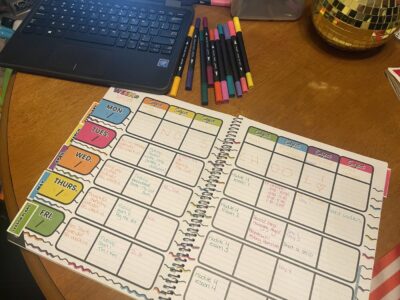
Do you have a templete for the “ one day per page or half”?? I have 4 levels in my room ranging from 1st -5th… I want all of them to have their own schedule. Wondering, do I push them and take away the picture schedule and just use words??
Thank you for all of your curriculum materials!! I’m diving into the Math and Language Arts…
Thank you,
Carla
I am going to post some templates to share! Will post this week!
Did you post the templates? I checked in your TpT store, but didn’t see anything. The board maker one did you use a template on board maker? (the one that says Mysabel) I have an old version of board maker. I also like the one that says Byron’s Schedule.
Thanks! You’re the best!
Did you post the templates? I didn’t see them in your store. I’m interested in the ones that say Byron and Mysabel. Thanks! You’re the best!
Did you post the templates? thanks!
I’m working on getting a bunch of templates together and am going to send them out in the next newsletter!
I have 4 levels in my classroom 3 – 6 structured academic. The classroom has levels from pre k to high school. I am a first year teacher and feeling lost. If you have any suggestions on where to start to figure out the levels of the students I would be grateful.
I’d start with visual schedules on the page. Students that can read – take away pictures and then have just words. Keep it all one page per day for consistency!
How can I find templates for the weekly picture schedule?
Unfortunately those are boardmaker so I don’t have a way to share them. Try a free subscription to Boardmaker online!