Monthly training, new resources, and a community of educators — JOIN THE WAITLIST

Tips for Using AAC with Task Cards

This week I want to continue to share about how to incorporate and use AAC systems with activities you are

Tips for Using AAC with Task Cards

This week I want to continue to share about how to incorporate and use AAC systems with activities you are

This week I want to continue to share about how to incorporate and use AAC systems with activities you are already doing with your students.  I have created lots of different task cards to target different language skills and this is another good time to use those AAC systems.  Previously I shared about using some different task cards with AAC systems and you can click the link to read ideas from that post – Using AAC with Task Cards.

Now I’ll go through some different task card sets and how to use AAC with them.  What Doesn’t Belong Cards are great to use with AAC systems.  Level 1 – I name the items on the card for the student and then I read the fill in the blank sentence.  “The ­­­___ doesn’t belong because ___.”  Usually the student will point to the picture on the card to determine which item meets that statement.  Then I have him/her find the item on their AAC device.  For example, the spoon does not belong with the tools.  The student would navigate the device and find the “spoon” icon on their device.

Level 2 – For my higher level students I can make them use a longer phrase or identify why the item does not belong in the group.  For example, instead of just having my student find “watermelon” they could say “watermelon not vegetable” eventually the student may work on formulating a more complete phrase/sentence such as “the watermelon is not a vegetable”.  This is a little more advanced then my students’ skill level and use on their devices right now.

Receptive Category Cards are another way to build up vocabulary skills.  These are good practice for the student to navigate to the correct category in order to find the item which meets the description.  Level 1 – I again first name all the items on the card or have the student point to the items as I name them.  Then I read the sentence to the student.  “Find the fruit”.  After the student points to the picture of the pineapple I have him/her find the item on their device.  Sometime I even have my student select the correct category symbol from a visual board of category symbols and pair it with the correct picture on the receptive category card.

Level 2 – Again for higher level students I just work on expanding those utterances on their device or answering questions about the items.  Instead of just selecting the “lemonade” picture to identify the drink the student could formulate “drink lemonade”.  You could ask “how does the lemonade taste?” and the student could find the “sour” icon on their device.

Time Preposition Task Cards target those tricky “in”, “on”, and “at” time concepts.  I created a set with visuals and a set with just the written sentence.  Level 1 – I usually read the sentence providing either two or all three choice answers.  For example “school is over in 3 o’clock or school is over at 3 o’clock”.  Then the student would select the “in” or “at” word on their AAC device to correctly complete the sentence.  Level 2 – Your student could work on formulating the entire sentence on their device.  “School is over at 3 o’clock”.  That is definitely more challenging.

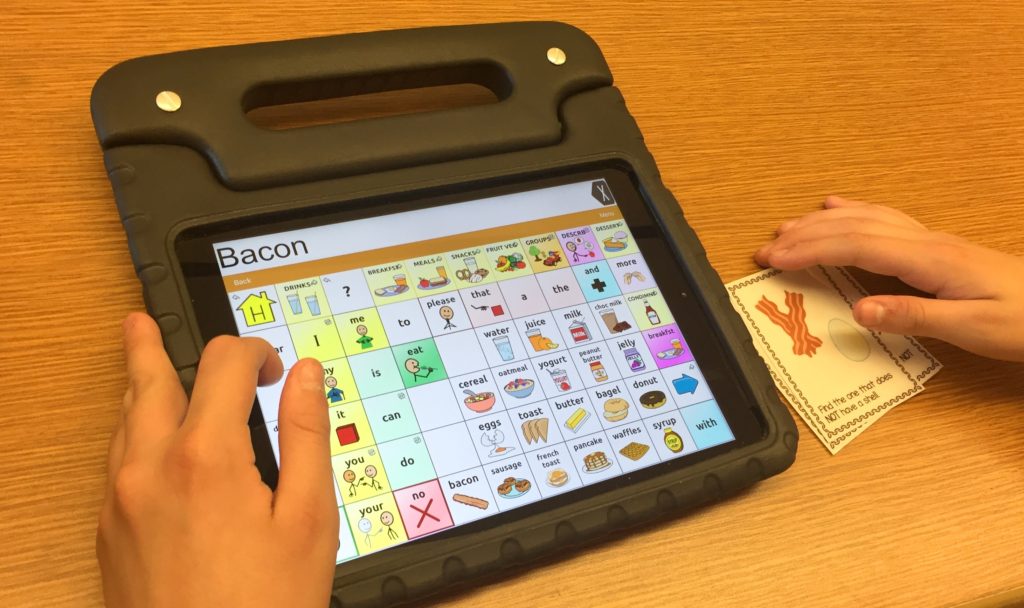
Non-Example Task Cards focus on that “not” concept which can be very difficult for our students.  Level 1 – I point to each picture on the card and name them for the student.  Then I read the sentence.  “Find the one that does not have a shell.”  After the student points to the correct picture on the task card I have him/her navigate to find the item on their AAC device.

Level 2 – You can work on having the student use a complete sentence.  Instead of just saying “soup” the student could formulate “soup is not cold” or “soup is hot”.  This can be pretty hard for most of our students.

Association Task Cards require the student to identify which 2 items from a group of 4 items have a relationship and then if they can determine why.  Level 1 –the student could just identify the 2 items which are associated with each other such as “eyes” and “glasses” and select those picture on their AAC device.  It’s an easier task to just identify which 2 go together and then also easier to find those items on their device such as “chicken” and “eggs”.

Level 2 – I would work on having the students identify “how” the items go together.  So for the spider and the web card the student can find “build” which I would take.  Your student may even be able to formulate “spider build web” which would be amazing.  You can work on some of the grammar later.

There are also different grammar task cards you can use with your students.  For example, you can use either the Is/Are or Has/Have Cards from the Helping Verb Grammar Card Set.  Have your student select the correct helping verb on their device to complete the sentence.  Hope this helps with some new ideas!

2 Responses

  1. organization question. What are the clear plastic boxes you have for storage of task cards? They look flat and stackable, I have limited storage space and I like the size of those! right now my cards are in an over the door shoe hanger on the back of my classroom door! your storage looks so much nicer!

Leave a Reply

Your email address will not be published. Required fields are marked *

Live & On-Demand Training

Picture of Sarah Allen, MA CCC-SLP

Sarah Allen, MA CCC-SLP

Related posts

Sweet Summertime Activities

I cannot believe it’s time to be writing a summertime post!  How is it already June (or maybe you’re thinking…finally)?…
Learn More

Spring Weather & Surprise Eggs

After so much (welcomed) snow this year, I was equally as excited to break out weather and spring activities! This…
Learn More

Supporting Students in Specials

Teachers often ask how they can best support students in specials classes (art, PE, music, technology, etc.). Below, I have…
Learn More

FAQ

Do you accept School Pos?

Yes! We are happy to work with school districts to complete orders from our store for individual or groups of teachers. We accept purchase orders, can provide formal estimates, or complete any vendor paperwork you may need to support your district’s purchasing process. Submit a PO to [email protected] or request our W9 to get started!

The Membership gives you continuous access to a growing library of professional development, monthly trainings, resources, and practical tools you can use right away. It’s designed for educators, clinicians, and teams who want consistent support, fresh ideas, and ready-to-use materials all year long.

Courses are focused, start-to-finish learning experiences. Each course dives deep into one specific topic with structured modules, step-by-step instruction, and a clear learning path. You move through the content intentionally to build mastery in that area.

Curriculum Access is a complete, standards-aligned curriculum platform with lessons, materials, data tracking, and implementation tools built for special education classrooms. It helps you actually teach the skills, not just learn about how to teach them.

The resources you purchase are delivered electronically. We will not be shipping any finished products to you – they are all electronically downloadable.

We offer a lot of free information on everything from behavior supports to academic instruction to communication skill building. Start off at our blog, check out our YouTube videos, listen to our weekly podcast, and go in-depth with our free webinars.

Contact us