So, I made my own civilization books!


- Day 1: Sense of Self Geography, Introduce the Material
Sleep on it
- Day 2: Sense of Self Geography, Engage Artistically
Sleep on it
- Day 3: Sense of Self Geography, Review
It should be noted about prep work: I always prep the week(end) prior to starting.
Day 1: Sense of Self Geography
Prep:
Before anything, choose the map(s) that best fit your needs. There are so many to choose from.

Student Learning:
Start each day with a sense of self geography. I used to say, “We are traveling to Egypt today!” Which lead to an anxiety filled reply, “Mommy go, Bubba stay home.” There was no way he was getting on a plane. So, I begin our history lesson with, well, a light heart, but also, a literal WH question, where do you live?
Then, ask where is…………which ever civilization you’re working on, whether it be China, Egypt, Mesopotamia etc. This gives multiple opportunities to know where they are on the map in relation to where they are studying.
Differentiate by changing the WH question:
What state do you live in?
Which country do you live in?
Where is the continent you live on?
Day 1: Introduce the Material
Prep:
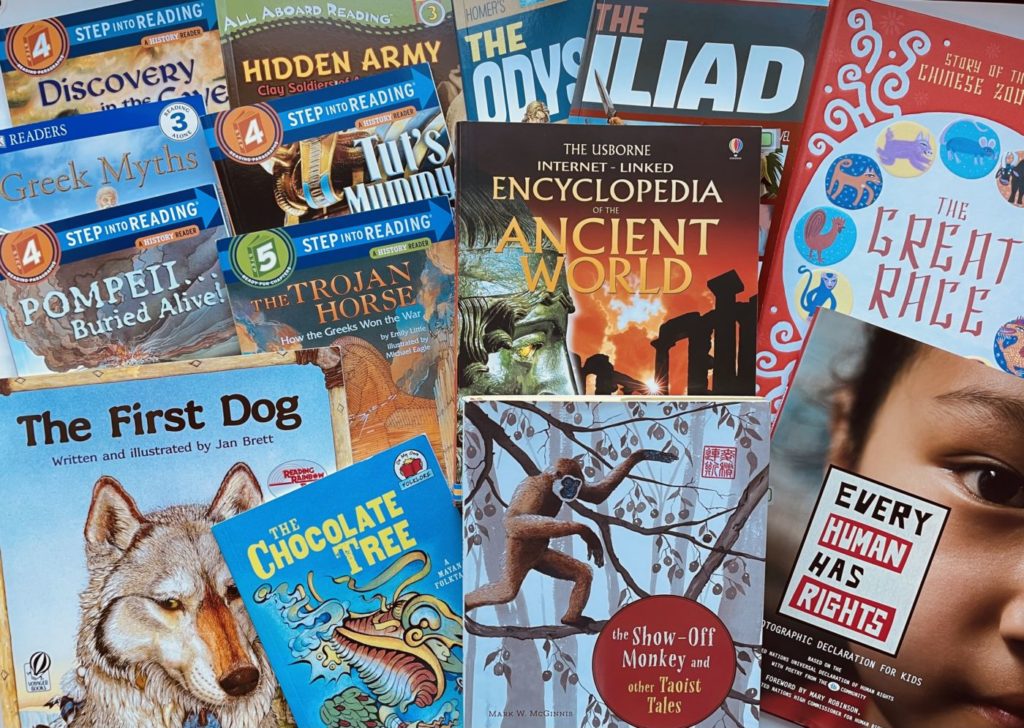
Without a doubt, pre-read the chapter and if you choose to do so, the suggested picture books, chapter books or readers, which are provided per chapter. These are not needed as it’s a complete history curriculum however, we use them on day 3, review, or a couple chapters per day.
Next, read the comprehension questions and vocabulary words that are provided in the guides, or change them based on your child’s level.
Student Learning:
Begin by having your child read or listen to the chapter. This can be independent, read aloud, or an audio book, like “Curiosity Chronicles”, which is also in dialogue format. I love this because it gives the opportunity for a shared read in scripted back and forth conversation.
When we do this, Bubba is always Ted because the lines are shorter.
Here are some awesome resources we use.


Map Work
Next up is mapping the ancient world. I didn’t like the zoomed in locations inside the workbook. While the size is great for big writers, it doesn’t give the larger scale perspective on, where in the world is Egypt?
To fix this, I traced each continent from a large map, cut out the pieces, gave Bubba a 20×30 foam presentation board, a map to compare locations and had him trace in the proper locations. This presented a great opportunity for writing/drawing, visual tracking and comparing.
Now, each chapter that adds a new location or river etc., he uses the world map he made himself.

Sleep On It
Unquestionably this goes for prep as well as the student learning. Taking the night to absorb the material helps with recall and connections.
Day 2: Sense of Self Geography
Day 2: Engage Artistically
Prep:
Create visuals from everything you previously read on day 1. The visuals should answer the comprehension questions and vocabulary you will use on day 3, review. This can be drawings you make yourself, pictures you found online, etc. The idea is to provide a visual that stays out during the chapter.
I create chalk drawings. This provides an amazing opportunity for me to model making a ton of mistakes without frustration and show him that art isn’t about getting it right, it’s about making it yours.


Along with your visuals, you should absolutely find videos! Youtube is a great place to find clips that liven the experience such as, seeing the inside of a pyramid and a deeper dive into the weighing of the heart. An awesome tip, turn the closed captions on; many visual learners need the words too.
Student Learning:
Watch those videos.
After all these visuals and listening, your child now creates what they heard from the chapter, saw in a video, or any additional books you may be reading, just as you did in your prep. I prompt with questions, and we re-create my chalk drawing on paper and/or a hands-on project.

Building the first step pyramid.

Re-creating my drawing of, “The Weighing of the Heart.”
If you build a project, definitely integrate technology and have them take a picture to put in their civilization book. We use this Cannon Selphy Printer.

Sleep on it
Day 3: Sense of Self Geography
Day 3: Review
Student Learning:
Following your day of art, you want to start reviewing all that you and your child have learned. First, add timeline pictures. We use the provided pictures and massive timeline to keep it out all year for an additional visual. For repetition, I print the pictures twice and he also adds them to this timeline book.


Lastly, your child writes a narration next to or under their picture in their civilization book that tells about the picture or project they made. This is where your artwork comes into play again. Ask those comprehension questions and vocabulary words using your work and/or theirs. Ask about location and the date using their map and timeline if they need visuals. I write down Bubba’s answers and he copies what I write.
I have seen major growth in history knowledge and enjoyment with Bub. Just recently we visited a museum that has a window of replica artifacts from all over and he pointed to King Tut’s chair and said, “Egypt.” Last week, he was watching “Sounder” and when the little boy was reading about pharaohs he said, “God-Kings.” Learning about the world has been an amazing experience for him.
“What we learn with pleasure we never forget”
Alfred Mercier

- How to Start Experiencing History - December 21, 2021
- How To Adapt Holiday Project Based Learning with Community Service - December 7, 2021