

When there is a wide range of learning levels included in one classroom, providing quality academic instruction becomes complicated very quickly. Whole group instruction may not be an option. If you plan to the middle of the group, the content may be way too easy for half of the class and way too hard for the other half. When things are too easy or too hard, it’s not accessible. When things aren’t accessible, students get bored. When students get bored, problem behaviors are more likely to occur.
You need to focus your energy on creating systems for small group instruction. When you utilize small group instruction, you can create activities and plan your academic content at a level that is more individualized and appropriate for that group of students.
Create Small Groups
Group together students based on their current skills and IEP goals. However there are other important considerations when creating groups. Look at the social and behavioral needs of each student. Ensure that the groups you are considering will give the student opportunities to practice and expand their social skills. Also consider behavior. If a student has high behavioral needs or frequent aggression or dangerous behavior, make sure that the other students can work independently. Plan for the worst case scenario right now. If you need to help that student de-escalate one on one, what will the other students be doing? Other considerations for creating groups are the students’ schedule, age, and grade.

Setup Independent and Adult Direct Centers
Since students aren’t going to be working with you all day, they need other things to do. Create simple independent centers and centers that can be run by paraprofessionals. DO NOT GET BOGGED DOWN BY THIS. I have seen so many teachers simply pause this center based instruction process all together because they want to wait to get the centers *perfect. Just get something ready. Keep it simple. You can always upgrade and update later.


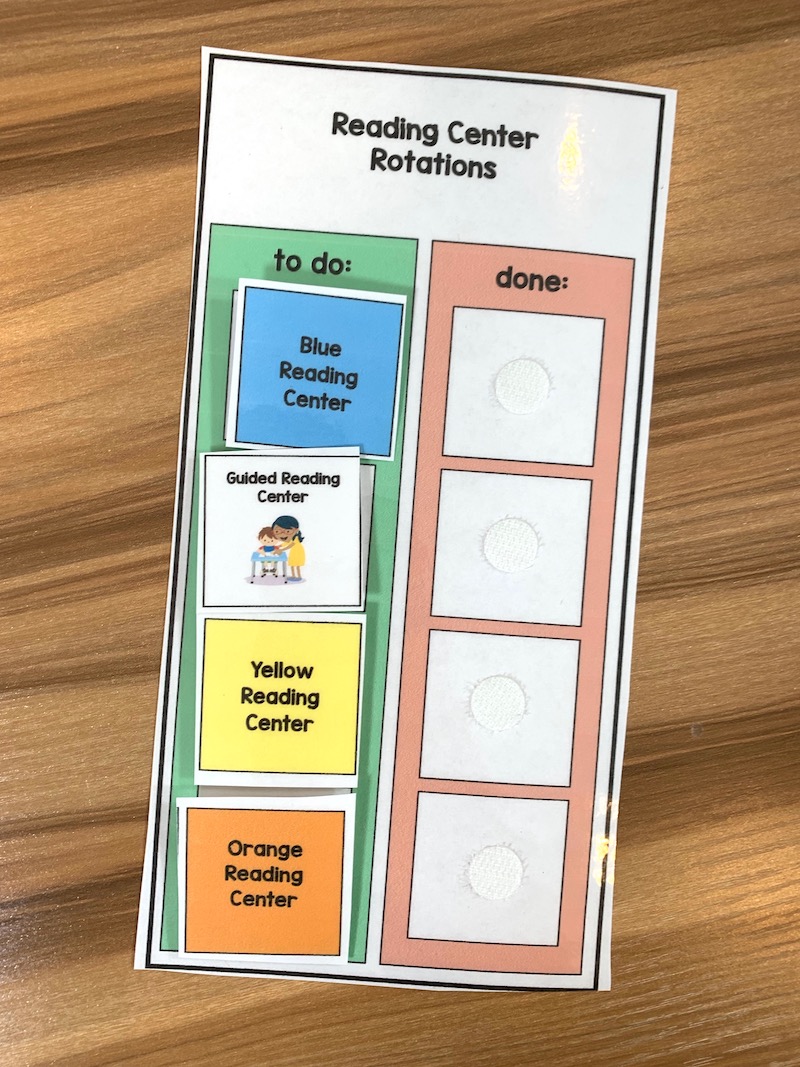
Establish and teach the system for moving between centers.
It all comes back to schedules! Ensure that there is a user-friendly way to show your students how to navigate between these centers. How do they know what is coming next? Then, teach that schedule. A schedule is a tool. And your students need to be taught how to use these schedules. Model, prompt, and fade prompts!

Plan for each group.
It may initially seem like planning for so many different groups is harder but I actually think it’s the opposite. When you can plan activities that are appropriate for the skill set of each group, your planning will come much easier. I love a simple, monthly template for each group. Reference goals and curriculum maps, write down one or two activities per day, and be flexible as life gets in the way!


- Planning for the Fall: Part 4 and 5 – Visually Structured Tasks and Routines - January 30, 2026
- Using TAH Curriculum for Homeschooling from a Homeschooling Parent - September 10, 2022
- Using The Autism Helper Curriculum for Homeschool - August 8, 2022


9 Responses
Thanks for all the information you provide. I am actually working on my masters in Special Education and your posts and your web has help and continue helping me in my projects and lessons plan. Thanks.
So happy to hear that Sergio! Thanks for reading 🙂
Thank you, your post are alot of help.
Hello! Random question; what font do you use? I’m looking for a font that has the “a” in the same style that it’s written.
Thank you for all you you do!
Hi Jane, the font we use is Open Sans 🙂
Hello, My name is Amy Sparks and I know that you are probably getting a lot of questions about how to set up classes for virtual learning. My question for you is do you have samples of a scope and sequence for each grade level and I do want to say that it does not necessarily have to be Common Core Standards. I would also like to ask do you have any templates and examples of lesson plans that I can show my teachers that have some students in their classrooms who are doing virtual learning. Our school has both face to face and virtual learning. I am the principal and the CEO and I am not allowing students to go back and forth. Once they sign up for Virtual they have to stay on this path for the first 9 weeks. We are also looking for a curriculum that can really meet the needs of our students and that are research- based upon the outcomes that they have had with Autistic children. Could you recommend a curriculum for autistic children that are high functioning around Junior High Level?
Hi Amy! Within my curriculum, I include a curriculum map within each level that should the progression of each focus topic through each unit. They are based initially on CCSS but designed to utilize for a range of grade levels. Hope this helps! https://www.teacherspayteachers.com/Store/The-Autism-Helper/Category/TAH-Leveled-Daily-Curriculum-203202
What have you found to be the best glue for attaching file folder activities to the folders? Both glue stick and white school glue seem to be detaching after the folders are laminated.
Joan, I haven’t encountered that problem as long as I use 5mL laminating pouches that are large enough for the folder (menu sized).