

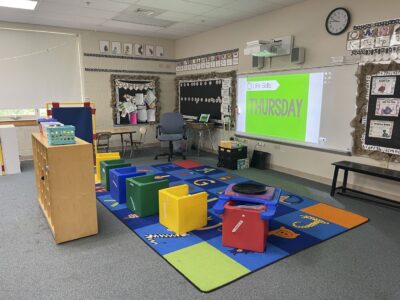
As we head into winter break, my number one goal is to be prepared and ready for resuming school in January, whether it be in person or remote. Using my plan time efficiently has been a main focus while working from home. Staying organized, on top and ahead of lesson planning, and maintaining boundaries are at the top of my list. My classroom is now in the loft of my house, right next to the bedrooms. Am I tempted to keep working after hours? Yes! Do I occasionally think about sneaking away to clean up a mess I left when my son and husband got home? Of course! However, keeping organized and maintaining boundaries help keep me from feeling stressed and too fatigued from work. In this post, I will show how I organize ONE area of my classroom. STAR (Strategies for Teaching Based on Autism Research) is the alternate curriculum that we use in our Educational Learning Skills classroom, both in home and in the classroom!


I have multiple boxes/copies of the STAR program, levels 1-3. I have put these in three different areas of our classroom so that the materials are handy at all times. Having multiple copies around the room gives me access to the program in our DTT center, my TAs have access at their centers, and the third copy stays in a different area of the classroom where we can work on generalization of skills. Having multiple copies also allows us to keep all of the materials inside of the boxes. I used to take all of the materials out of the box, thinking I was helping. This caused major malfunctions! We would lose materials, forget where we put things, my learners would throw something across the room, and that caused us not to be set up and ready for the next learner during rotations. Keeping everything in the box and in different areas of the classroom help confirms that we know where everything is!

STAR has a very organized system for how they store the lesson folders and directions. I like to keep these in the boxes that they correspond with. If I ever need to revisit or forget exactly how to run a lesson, when a lesson is mastered, or which materials are needed for that lesson, these are great to look back on. Leaving these in the box and in order make it easy to find it quickly, to preserve instructional time.
The order that they stay in in each box is:
- Discrete Trial: Receptive language
- Pivotal Response Training: Expressive language
- Functional Routines
- Discrete Trial: Pre-Academics
- Pivotal Response Training: Play and social interactions


The only aspect of STAR that we “split up” are the data sheets. We have found that it is easiest for us to keep the DTT data sheets, the Functional Routine Data sheets, and the Pivotal Response Training data sheets separate. I will review how we split, and organize each of these!
Discrete Trial Training
Each student has their own binder for all DTT lessons. These binders are kept in my DTT center and they are ready for each 1:1 rotation. The binder starts with a “DT Programs Covered” page where we track which programs were covered on which days. Next is the level cover page where we track when a program was introduced and when it is mastered. Last are the data sheets. These were included in the STAR black line masters. Each program has their own data sheet where we track progress.
Functional Routines
We have found that keeping the functional routine data sheets on clipboards makes it much easier to grab and go! Each clipboard is stationed at the corresponding area of the classroom. There is a cover page in a page protector with each child’s name on it. We use a wet erase marker to check off each child’s name once data has been taken that week. At the end of the week, whomever does not have a check mark in any functional routines, we know that we need to take data that day. At the end of the day on Friday, the checks are erased and ready to start again on Monday.



Pivotal Response Training
We keep our PRT data sheets in a binder in the play area, divided by each learner’s name. When a learner comes to an area of the classroom where we work on PRT lessons, we have the binder full of blank data sheets that are ready to go. This saves instructional time! Any team member will grab a blank data sheet, write the appropriate information on the top, and work on the PRT programs. Each child rotates through the play area at least 3 times per week, which gives us adequate time to teach, practice, and assess these skills.
Putting it together
Please enjoy your break. You deserve time to walk away from any screen and any teaching tools! Connect with your family, friends, and most importantly, yourself. Write a list of what MUST get done your first day back to school. If you are feeling overwhelmed with the STAR program materials and data sheets, consider organizing your materials so you set yourself up for success!

- Embedding Social Skills Into Every Lesson - November 24, 2025
- Top 10 Must-Do Tasks from a Self-Contained Elementary Teacher - September 22, 2025
- Setting Up the Classroom Environment for Independent Learners - August 20, 2025
2 Responses
Did you make those STAR sheets that say programs covered and date started/mastered?
Hi, I created these for my programming, yes.