
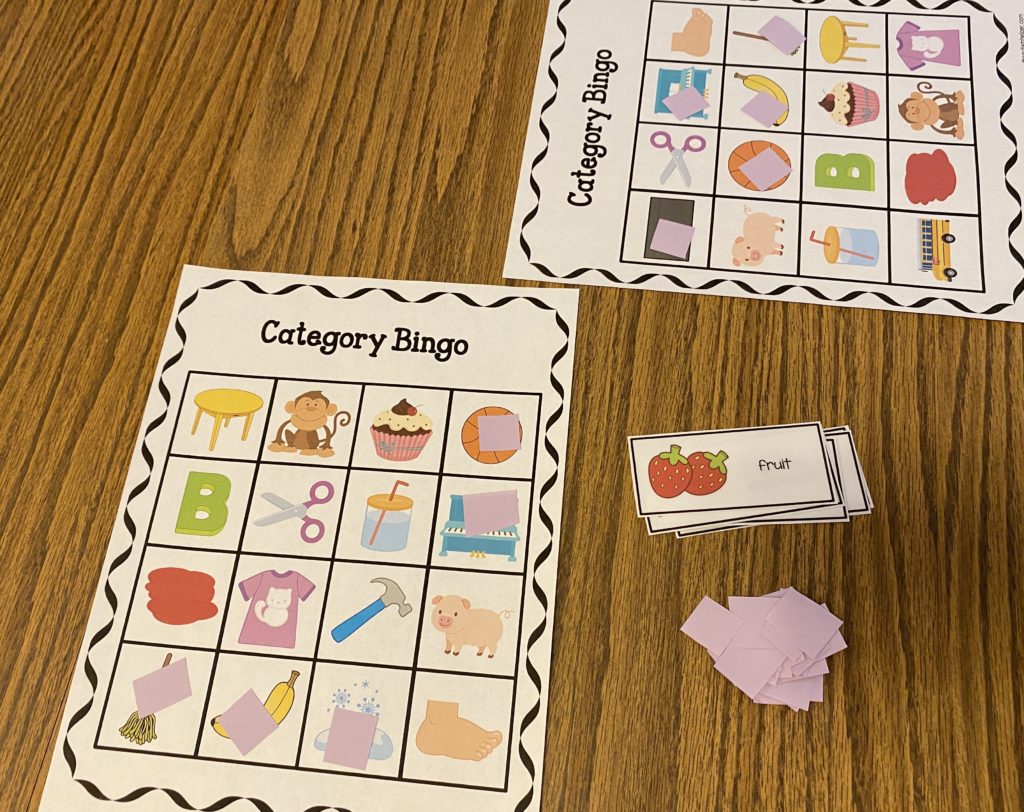
Looking for more activities to send your students or for parents to use with your children at home? Check out these Category Bingo games. I’m super excited to share them with you. I wanted to create something fun for parents to use with their children at home while still working on some important language skills. I created 2 different levels of this bingo game so hopefully one of the levels works for many of our children. Each game has 6 different boards so you can play with more than one child and play multiple times.

I know most of you don’t have laminators at home but that is totally fine. You can just print out the boards and use them as is. Even if you have to print them in black and white that’s okay. The only square you would need to add some color to would be the spot on the board to represent the color category group. You can trace/color the spot with a marker or crayon. If you have some plastic page protectors at home you can also put the game boards in those to protect them. Then just cut out the category calling cards and put them in a Ziploc bag.

I’ll give you a little overview of the 2 different versions. Category Bingo Level 1 targets 20 different common categories. There are 16 categories on each board meaning not all the categories are on each board. I like to do this so you can use the boards a few times to play or if you have more than one person playing the game then not all the boards are not all the same. For this set I paired a visual with the calling cards but not the exact same picture as on the boards. So if you said “shape” I paired a visual with the shape category but now your child needs to look at their board and see if they have a shape on their board. If they have the rectangle they can put a marker on the rectangle picture. You can use anything you have around the house as board markers. You can use coins, chips from other games you might have, or even just cut up a piece of construction paper into small squares.

For the fruit category I put a picture of strawberries on the calling card but the child would need to look at their board to see if they have the banana on their board. If they do they can put a marker on the picture of the banana.

Level 2 targets those same 20 categories from Level 1 but then I added an additional 10 categories for a total of 30 different categories. Each of the Level 2 Bingo boards will now have 24 categories on it. Again all 6 boards will be slightly different. I also used 2 different pictures to represent each category. For example if the category was “school supplies” you might either have a picture of “crayons” or “glue” on your board for that category.
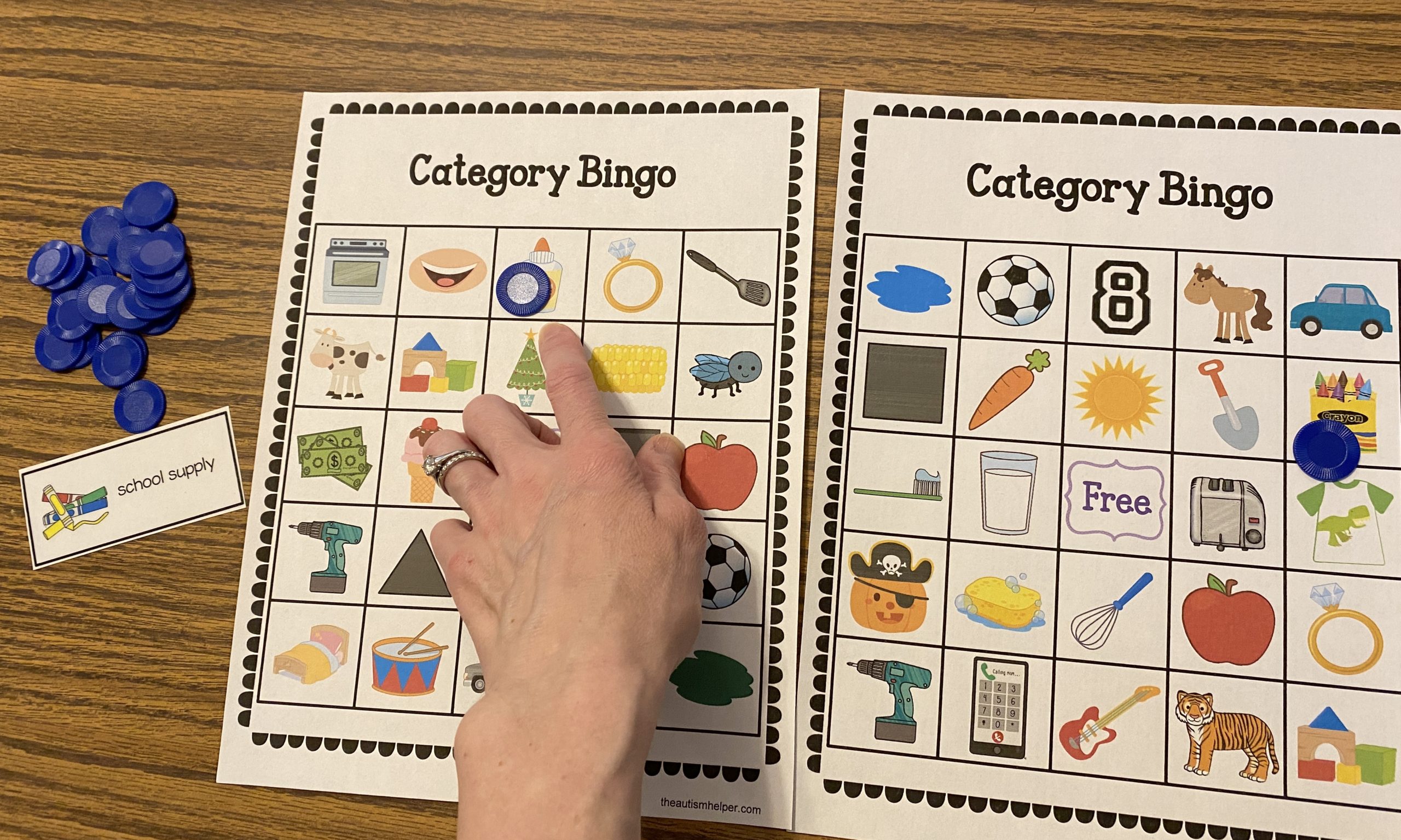
If the category was “tools” you might have either a “drill” or “saw” on your board or maybe neither. Hopefully with different items to represent each category you will be able to play this game multiple times with all the different options.

To make it even more challenging you can use the calling cards without the visual support. Now you or your child can read the category name and then figure out what items are in that category without the added visual support of the category concept. You can also use the calling cards to have your student try to name 2-3 items within each category. Make that a game and each person tries to think of something different to add to each category. For example, “tell me 2 cooking utensils”.

Here is the link for this game – Category Bingo
Keep learning and stay safe!

- Vehicle Themed File Folder Activities - May 18, 2021
- Counting and Sorting Vehicle Fun - May 4, 2021
- What Color is the Vehicle? Adapted Book and Free Vehicle Themed Bingo Games - April 20, 2021


