
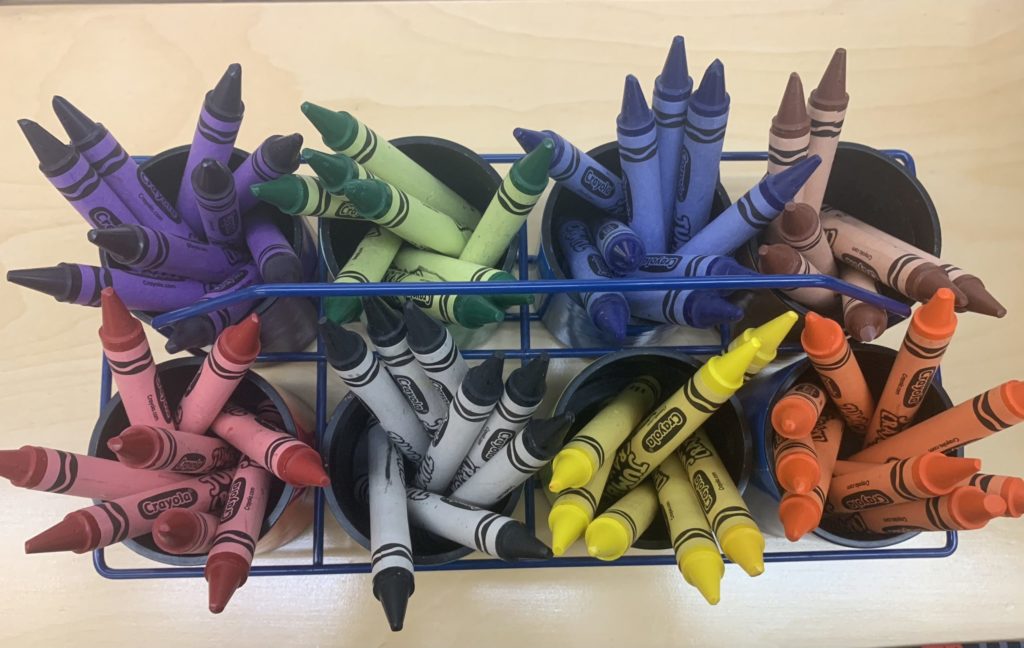
Coloring is another important school related fine motor skill for children to learn. While some students may be very motivated to color independently, other students may need more support to engage successfully. There are some simple ways you can support your students as they learn to color. Here are my top 5 tips!
1. Check Form
Posture and positioning can be very important for many fine motor skills. When coloring, it is important to look at the student’s wrist and forearm. You want to see the forearm resting on the table, and the back and forth coloring movement should be coming from the wrist. You should observe the wrist bending back and forth, and not the child moving his whole arm to color. If the child’s forearm is not on the table, and he is also using his whole arm to color – you can try using a vertical surface like a wall or a slant board when working on fine motor activities. You may also want to reach out to your OT for more suggestions.
2. Modeling
Don’t underestimate the power of modeling the back and forth movements of coloring. I like to sit next to my students and color along with them. This seems to help those students especially who may need more pracitce with the back and forth nature of coloring and also the overall goal of filling in the space with color.


3. Start with Simple, Small Shapes
I like to set my students up for success especially as they learn a new or challenging skill. Instead of jumping right to more complex pictures, I like to start by having the student color simple, small shapes. It is more clear exactly what needs to be colored, and the small shape increases the likelihood that the child will fill it with color successfully. You can continue to build on this success going forward!
4. Defined Borders
One of the trickier parts of coloring, besides learning to fill the space with color, is attempting to stay inside the lines. I like to use a marker to make the border of pictures very bold. Additionally, you can use a wikki stick or hot glue to make a raised border which gives some good tactile feedback.


5. Change It Up
It can be important to keep coloring activities novel and exciting! You don’t just have to practice coloring skills while sitting at a desk, using crayons and paper. I love to switch up the location and position of activities. One of my favorite coloring activities is under the table coloring! Tape a piece of paper under the table and have the student lay on her back to color. You can also use different materials to work on skills like staying in the lines and filling the whole shape, such as fingerpaints, shaving cream or chalk.
What are some of your favorite ways to work on coloring skills?
This blog is for informational purposes only. The information provided is general in nature. Please reach out to your OT for specific recommendations.

- 5 Items I’m Adding to my OT Toolkit This School Year - September 10, 2025
- 5 OT Tips for Creating a Regulating Morning Routine - August 13, 2025
- Thinking Ahead: Preparing for Life after Graduation - January 15, 2025

4 Responses
I dont know who can help my grandson, he was born with a brain bleed, thus has hydrocephalus and has had 3 brain surgeries by the age of 2, has a shunt in his head. At the age of 2 1/2, was diagnosed with mild autism. He is 7 years old, doesn’t speak, not potty trained, doesn’t use silverware. We are happy that he can walk, run, loves to tickle and has the biggest smile ever. He was a full term baby. Has went through the flapping of hands, spinning everything, and now puts everything in his mouth to chew. His parents have put him in speech therapy, ABA sent people to the house, they have spent a lot of money for years, until one of the professionals told the parents…there is nothing else we can do. He has went to preschool for 3 years and is now in a special needs class at school. He loves water.. and when frustrated, gets a lot of showers, that helps calm him down. I heard of brain mapping?? Do you know anything about that, or anything that can help. He spoke just once when he was around 4 or 5. He said two words…SWIM MAMA….never spoke before or since . I pray everyday for a miracle.
loved it!
Happy to hear! Thanks for reading 🙂
It sounds like he is receiving a lot of great supports and has a wonderful family that advocates for him. Continue to advocate for services and data-based decisions within those services and his classroom. If you want specific recommendations from our Product Manager and speech-language pathologist on materials to use with him, email [email protected]